



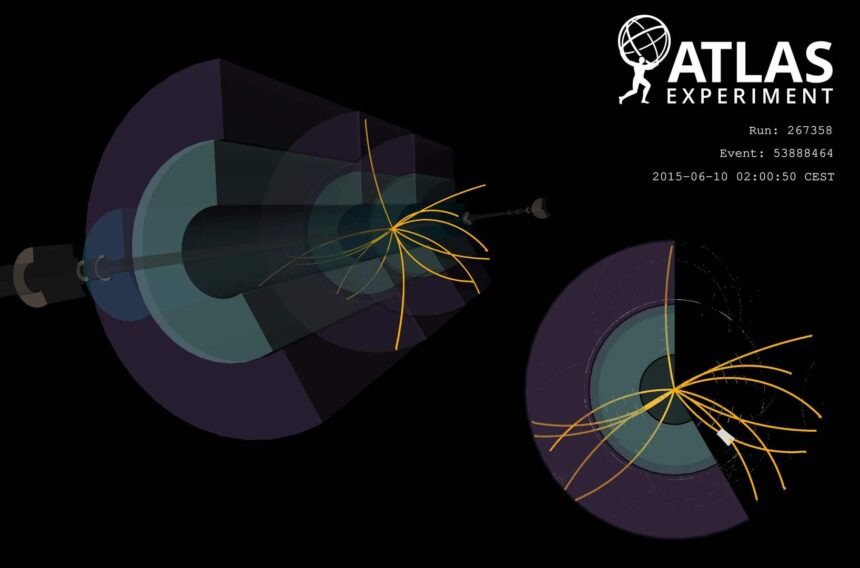
Scientists from the University of Bonn, together with colleagues from Oxford and Prague, have taken part in a study of particle collisions recorded at CERN's Large Hadron Collider. According to the ATLAS scientific collaboration, the particle pattern being investigated was observed more frequently in proton collisions than predicted. This could point to a phenomenon predicted by the Standard Model of particle physics but never directly observed: instanton processes in quantum chromodynamics. If this hypothesis is confirmed, scientists will be able to demonstrate that the structure of empty space has a measurable effect on particle collisions. The research could also open up new opportunities to investigate the imbalance between matter and antimatter in the universe. The findings have been published as a preliminary scientific paper on the arXiv platform.
**A 50-year-old prediction put to the test**
Quantum chromodynamics describes the force that holds quarks together inside protons and neutrons. The field associated with this force has a particular structure even in empty space and can become twisted in different ways. Through the phenomenon of quantum tunneling, the field can transition from one state to another. These transitions are known as instanton processes, which are difficult to describe using conventional computational methods.
Matthias Schott, a professor at the University of Bonn and an expert in experimental particle physics, notes that the Standard Model has predicted such transitions for around 50 years. Detecting them in particle collisions would make it possible to study the topological structure of empty space and test a long-standing theoretical prediction in a laboratory.
Related News
**What the detector recorded**
According to the theory, a collision resulting from an instanton process produces a large number of relatively low-energy particles that spread almost uniformly in all directions. However, ordinary proton collisions can also produce a similar pattern, making it difficult to distinguish clearly between the two phenomena.
What makes this research distinctive is that scientists are attempting to experimentally test a prediction that has existed in theory for half a century. In particle physics, a theoretical calculation does not in itself constitute a discovery: detectors must record the corresponding signal, and independent analyses must confirm its interpretation. This is the stage ATLAS's work has now reached.
For now, the observed excess is a possible hint of instanton processes, not their definitive detection. This distinction is crucial because ordinary proton collisions can also produce similar patterns. Further studies will need to establish whether the signal persists in other types of collisions and when different analytical methods are used.
If the findings are confirmed, the significance of the research will extend beyond studying the structure of empty space. It could open a new experimental path toward investigating the imbalance between matter and antimatter, a question scientists have yet to answer. However, these are two separate issues: instanton processes do not themselves change this ratio, but they could help scientists study physical conditions in which other processes that alter the balance also operate.