



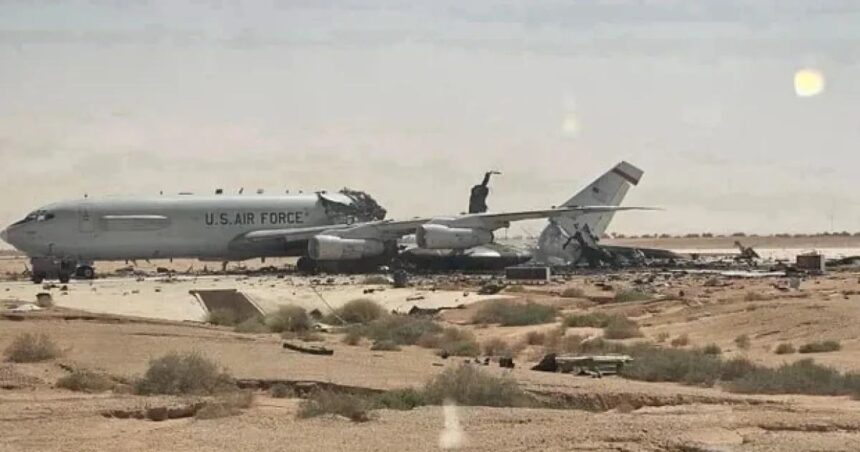
Exclusive photographs have been published showing the extensive damage sustained by a number of American military facilities in the Middle East from Iranian missile and drone strikes.
The photographs were provided on condition of anonymity by active-duty American service members, as strict media restrictions are in place in the military.
One of the frames, taken at Prince Sultan Air Base in Saudi Arabia, shows a four-engine Boeing E-3 Sentry aircraft that took a direct hit. Other photographs depict burned buildings and barracks, alongside which concrete protective walls — so-called T-walls — remain standing. These were previously considered reliable protection, but proved ineffective against airstrikes.
Heavy damage was also recorded at Camp Buehring military base in Kuwait.
According to a new report by the US Department of Defense Inspector General, the value of equipment losses during the war against Iran could reach $3.7 billion, including nearly 60 aircraft. The report notes that US Central Command recorded Iranian strikes against American bases in Kuwait, Bahrain, Qatar, the UAE, Saudi Arabia, Iraq, Oman and Jordan.
The Pentagon did not respond to a request for comment.

The true significance of these photographs is not the burned barracks, but what they say about the defense of American bases. The T-walls, which for years were considered a reliable barrier against ground threats, turned out to be useless during strikes from the air. This raises a serious question not only about those specific bases, but also about the security of the American presence across the entire region.
The figure of $3.7 billion and 60 aircraft is impressive, but it is still unclear whether that is a final tally or merely an initial estimate. The report lists eight countries where American bases were struck, demonstrating the geographic breadth of the attacks. At the same time, the Pentagon's silence in response to inquiries is routine in such situations, but it further obscures the picture: without official confirmation, it is difficult to understand which part of the losses is truly irreversible and which part is recoverable.