



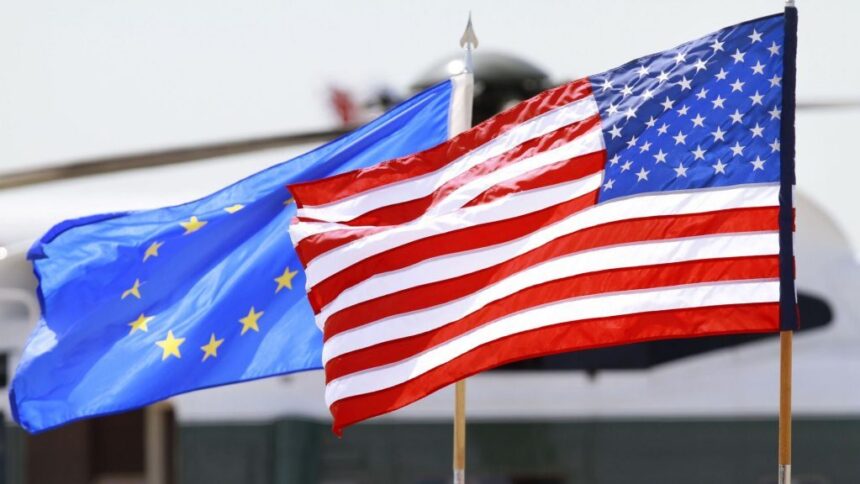
The US ambassador to the EU, Andrew Puzder, has stated that European companies will face a "devastating" response from Washington if Brussels proceeds with plans to restrict access to certain segments of the European market for American competitors. He said this in an interview with the Financial Times.
The matter concerns a European Commission proposal that would reserve the portion of the radio frequency spectrum enabling smartphones to connect directly to satellites for European companies. This would limit access to those frequencies for Chinese and American companies, including SpaceX.
Asked whether European companies should be concerned about retaliatory measures, Puzder said they "should be careful because such a step could be taken, and it would be very devastating for those companies," given the size of the American market. According to him, if the goal is "to reduce US competitiveness, then that is not a legitimate objective for adopting such legislation." "European companies' competitiveness cannot be increased by reducing the competitiveness of American companies," the ambassador added.
SpaceX, for its part, has sharply criticized the European Commission's proposal. The company warned that the move could lead to a deterioration in communication quality in Ukraine, where Starlink is critically important.
On October 14, Ukrainian military personnel reported that they had encountered restrictions in the operation of Starlink satellite communication terminals, more specifically their military version, Starshield. This occurred against the backdrop of growing tension between Ukrainian President Volodymyr Zelensky and US President Donald Trump. However, Trump insists that he did not order restrictions on the terminals' operation and does not know who did.
Meanwhile, The Telegraph's sources reported that the proposal to restrict Starlink's operation in Ukraine was presented to Trump by SpaceX head Elon Musk, and the US president agreed.



Brussels' initiative is not yet law, but it already demonstrates how the topic of technological sovereignty can turn into a serious trade confrontation. If the European Commission does indeed block frequency access, the first to suffer will not be large companies, but rather the European consumer and services dependent on satellite communication.
It is noteworthy that Puzder's threat comes at a moment when tension over Starlink's operation in Ukraine has not yet subsided. This shows that satellite communication has long ceased to be a purely commercial topic and has become a geopolitical lever.
How far the EU will be prepared to go down this path remains unclear. In any case, this issue will remain at the intersection of European and American agendas in the coming months.