



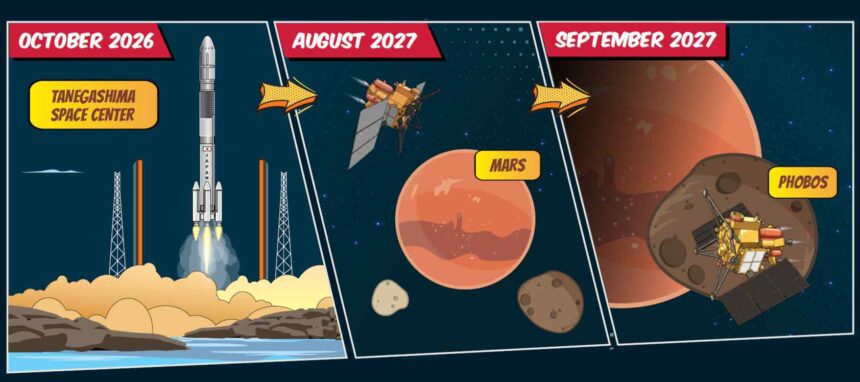
The Martian Moons eXploration (MMX) interplanetary mission is set to launch into space from Japan's Tanegashima Space Center aboard an H3 rocket, with the primary objective of collecting samples from Mars's moon Phobos for the first time and returning them to Earth. The project is led by the Japan Aerospace Exploration Agency (JAXA) in close cooperation with NASA, as well as French, German, and European space agencies.
Mars has two moons, Phobos and Deimos, whose origins remain an unsolved mystery to scientists. They may be asteroids captured by the Red Planet's gravity, or they could have formed from debris ejected by a massive impact onto the Martian surface.
Real rock samples are required to find the answer to this question.
Under the schedule, the spacecraft will reach Martian orbit in August 2027 and begin orbiting Phobos to study it from a distance starting in September. In early 2029, the 25-kilogram "Idefix" rover will be deployed onto the moon's surface, where it will weigh just 15 grams due to Phobos's extremely weak gravity. The rover will analyze the surface composition and relay data to prepare for the safe landing of the main probe.

The main spacecraft will touch down on Phobos in 2030, collecting valuable samples using specialized equipment. Following this, the craft will begin its journey back, becoming the first mission in history to return to our planet from the Martian system. The return capsule is slated to arrive on Earth in 2031, landing in Australia to deliver at least ten grams of extraterrestrial material to scientists.
Those ten grams of material could completely transform our understanding of the Solar System. Scientists note that the complex instruments available in Earth laboratories are vastly more powerful than devices sent into space, meaning the returned samples will serve new research for decades to come.



Returning samples from the moons of Mars is technically far more challenging than standard orbital observations. Testing a round-trip journey and landing under microgravity conditions will demonstrate how prepared humanity is to retrieve material directly from Mars in the future.
Analyzing Phobos's chemical makeup could settle a decades-long scientific debate. The distinction is crucial: if the moon consists of fragments from Mars's ancient crust, it may preserve traces of the Red Planet's watery past and potential signs of life.
All of this also represents a major test of international cooperation. If the 2031 return succeeds, it will stand as one of the greatest space achievements of the coming decade.