




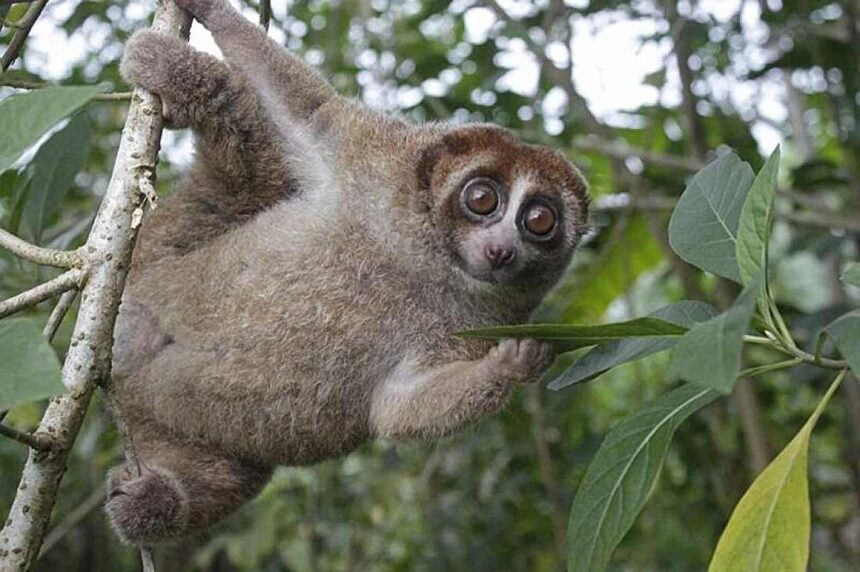
On Indonesia's Bangka Island, scientists have confirmed the existence of a rare venomous primate that had not been recorded in scientific literature since the 1930s. The big-eyed slow loris has lived alongside people all this time: the animals were found in yards, near roads and on power lines. A new study has shown that the species, which was considered on the brink of extinction and possibly already extinct, has survived in various parts of the island.
The study's findings have been published in the scientific journal Spixiana. They are based on data on more than 90 Bangka slow lorises that staff at the Alobi Wildlife Rescue Center took in between 2015 and 2025. Local residents and government representatives reported the animals they found, and specialists provided them with care and, after recovery, returned them to protected forests.
Of the more than 90 rescued primates, 86 recovered and were released at seven sites on the island. The specialists chose the locations taking into account the degree of forest preservation and the existence of legal or de facto protection. The animals were found in all four districts of Bangka Island, as well as in the city of Pangkalpinang. This indicates that the species most likely inhabits a significant part of the island.
The Bangka slow loris is included in the International Union for Conservation of Nature (IUCN) Red List among critically endangered species, with a note of "possibly extinct." Although there had been no confirmation of its existence in scientific publications for nearly a century, local residents continued to encounter these animals.


The fate of the island's forests will be decisive here. If illegal tin mining and the expansion of palm plantations continue at the same pace, the species' return to the wild may remain only on paper. The release of 86 animals is good news, but it still says nothing about their subsequent fate.
Another thing is noteworthy: locals have lived alongside these animals for decades, while science considered them extinct. This is a reminder that field data often reach the truth faster than official lists.



The researchers' proposals—genetic studies, captive breeding and monitoring—require funding and years. The question is whether they will manage in time, while the island's forests are still sufficient for this species.