




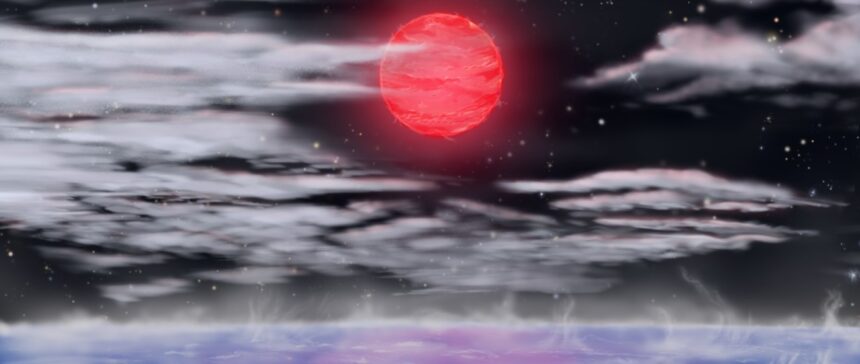
Astronomers have re-evaluated the parameters of exoplanet GJ 3378 b, discovered in 2024 and located just 25 light-years from Earth. Previously, scientists believed it was too massive and unlikely to be suitable for life. A new analysis has shown that the planet is lighter than they thought and is located within its star's habitable zone.
GJ 3378 b orbits a red dwarf star in the direction of the constellation Camelopardalis. Red dwarfs are smaller and cooler than the Sun, so their habitable zone is closer to the star. In this region, liquid water could even be sustained on the planet's surface, provided it has a suitable atmosphere.
The planet was discovered using the radial velocity method. Astronomers measure small wobbles in a star; if there is a planet nearby, its gravity slightly tugs the star from side to side. These movements can be used to estimate the planet's mass and orbital period.
Early calculations estimated GJ 3378 b's mass to be about five times that of Earth. With such a mass, the object could have retained a dense gaseous envelope. In this case, it would not be a rocky planet but rather a mini-Neptune. A team led by Paul Robertson from the University of California, Irvine, refined the data; its mass is now estimated at 2.3 Earth masses.

The orbital calculation has also changed. Instead of 25 days, the new data indicates the planet completes an orbit around its star in 21 days. This means its orbit passes through the red dwarf's habitable zone.