



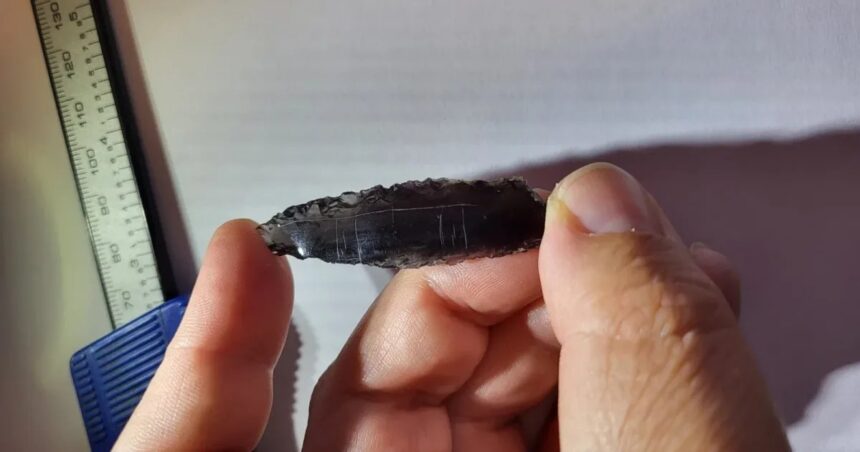
Archaeologists in central Turkey have uncovered 11 obsidian arrowheads bearing unusual engravings made nearly 9,000 years ago.
Following these discoveries, the total number of such mysterious artifacts has reached 54, and every single one is unique in its kind. The artifacts were discovered at the Neolithic settlement of Tepecik-Çiftlik in Cappadocia, which existed approximately between 7100 and 5800 BC. This region was situated between two major deposits of obsidian—a volcanic glass—from which local inhabitants crafted sharp tools and weapons.
Until recently, researchers had found around 740 obsidian arrowheads, but only one of them bore unusual markings. The situation changed dramatically after 2022, when archaeologists successively discovered 11 more similar specimens. Microscopic examination confirmed that these engravings were not random scratches, but were executed with specific intent. Experiments demonstrated that leaving such marks on obsidian required a harder material—flint—which was very rare in that area, forcing craftsmen to specifically search for suitable tools.
Some arrowheads were incised just a few times to produce a visible white line on the black surface. On one of them, the engravings were made at least 20 times, creating a complex pattern consisting of three squares connected by a line. However, scientists have not yet managed to find any common system, as none of the patterns are precisely repeated.
According to one hypothesis, these marks might have been hunters' unique "signatures" used to identify slain game. Nevertheless, their rarity and the uniqueness of the patterns suggest that they could also have served a ritualistic or decorative purpose.
This discovery is significant because it forces a reassessment of the social and cultural behavior of Neolithic communities. If the engravings are indeed personal "signatures" or ritual symbols, it points to the existence of individual identity awareness and complex beliefs among the people of that era.



Interestingly, although Cappadocian obsidian was widely exported during that era as far as the southern Levant, such patterned arrowheads have so far been found exclusively in central Turkey. This indicates that the active tradition or mysterious ritual was strictly local in nature.
Future excavations may prove crucial to fully solving the mystery, especially if similar artifacts are found at burial sites. That would make it possible to establish a direct link between specific individuals and these unique weapons.