




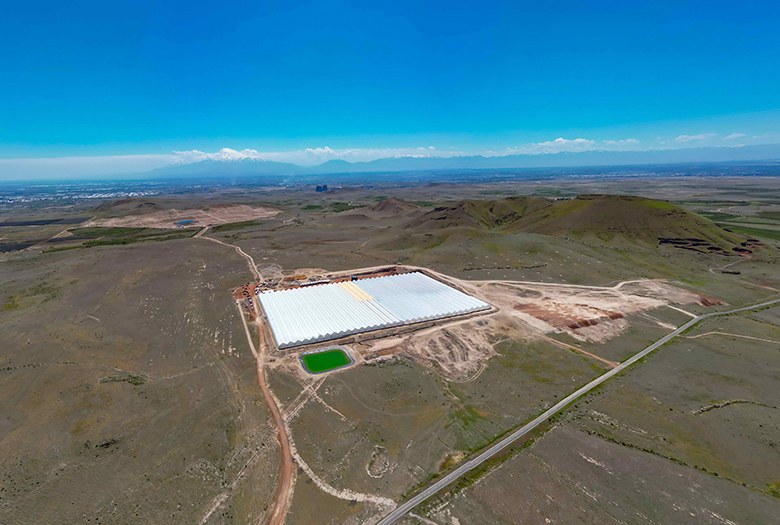
A unique greenhouse complex has officially opened in the village of Nor Edesia in Armenia's Aragatsotn Province, where tomatoes are grown using artificial intelligence, robotics, and cutting-edge technological solutions.
The facility's "smart" system continuously scans the entire area, collecting and analyzing data on the number of tomatoes, their ripeness levels, the overall health of the plants, and even the presence of pest insects, allowing for an immediate response to any deviations.
The plants grow in a clean substrate made of coconut fiber, and all necessary nutrients are delivered to them via a modern drip irrigation system, guaranteeing high-quality and environmentally friendly yields.
Currently, the greenhouse produces an average of 18-20 tons of tomatoes per day, which are exported daily to Latvia, Bulgaria, Romania, the United Arab Emirates, and several other countries. In the near future, production volumes are expected to reach 40 tons per day.
"During the financing of this project, there were many questions, but trust was the deciding factor here, and we boldly moved forward along the path of financing—something that started as just an idea on paper, and today the result is visible and tangible. We are proud to have supported this serious endeavor," said Hakob Andreasyan, CEO of Acba Bank, adding that in difficult times, it is important to maintain optimism and view every crisis as a new opportunity.
"Artificial intelligence controls everything here. Besides that, we also have a special robot that constantly monitors the entire greenhouse, so we are always aware of how many tomatoes we have, what their ripeness stage is, whether there are any diseased plants, and we even know which insects have appeared in the area," said Hayk Hunanyan, founder and director of Agro Prom, emphasizing that the support of Acba Bank and Acba Leasing has been pivotal in their business development. The complex was fully financed by the bank, while the technical equipment was provided through cooperation with the leasing company.



Construction work has already begun on a new complex on an adjacent 10-hectare plot, and there are also plans to build a production facility that will produce the necessary packaging.
This project seemed impossible for Armenia just a few years ago, but today it is already a reality. It is important that such solutions do not remain isolated examples but become benchmarks for the entire agricultural sector. Also noteworthy is that the investors speak of trust, which is often lacking in large-scale projects—and in this case, it truly worked, turning an idea on paper into a functioning complex.
Interestingly, the plans to double production volumes coincide with the construction of the new greenhouse, meaning the company is not only strengthening its position but also thinking about scalability. It remains to be seen whether the export geography will expand after the new complex becomes operational, or whether the company will focus on consolidating quality in existing markets—but in any case, this is a serious step toward the technological transformation of Armenia's agricultural sector.