



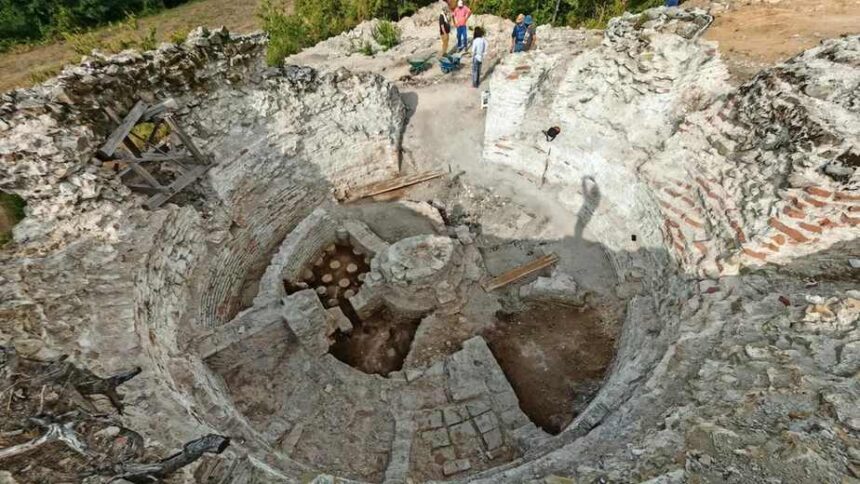
Archaeologists in eastern Serbia have uncovered the remains of a luxurious private bath complex that belonged to the Roman Emperor Maximinus Daza. Located at the lower level of the imperial palace's tower, these thermae feature an exceptional layout that even experienced scholars of the Roman Empire have never encountered before.
This remarkable find was made at the Vrelo-Šarkamen archaeological complex, a monumental fortified residence built in the early 4th century. The palace is associated with Galerius Valerius Maximinus, better known as Maximinus Daza, who ruled the empire from 310 to 313.
Experts were particularly intrigued by the layout of the baths. Unlike the majority of known Roman thermae, where halls typically had a linear arrangement, this complex featured a circular layout. Above it stood a vaulted ceiling with six windows, clearly demonstrating the high level of engineering achieved by Roman builders.
The baths consisted of two main sections. One contained the technical equipment necessary for their operation, where researchers discovered a floor-heating furnace and the base of a copper boiler used to heat water, though the boiler itself has not survived.
The second section was intended directly for the emperor and his inner circle. Here, archaeologists found three pools or tubs, as well as a sudatorium—a chamber designed for steam procedures, effectively functioning as a Roman sauna.
Researchers are confident that the complex was not intended for ordinary hygiene. It was a private space designed for the elite, seamlessly combining architecture, a heating system, and luxury.


Maximinus Daza was born in the territory of modern-day Serbia and was a participant in the Tetrarchy created by Emperor Diocletian. Under this system, the empire was ruled simultaneously by several rulers. The system later collapsed, and Daza engaged in a struggle for supreme power with other claimants, ultimately dying in 313 after losing a civil war against Licinius.
Scientists will continue their research to determine the connection between the rooms and details regarding their use by the imperial family.
The circular thermae discovered at Vrelo-Šarkamen shed important light on Late Roman architecture and imperial daily life. Such unusual engineering solutions show how much attention was paid to personal comfort, even within a militarized fortified residence.
This discovery also reaffirms the significant strategic and political role of the Balkan Peninsula, particularly the territory of modern Serbia, in the early 4th century. During the era of the Tetrarchy, emperors born and raised in this region sought to transform their birthplaces into lavish imperial centers.



Further excavations may reveal new technical details regarding the heating and water supply systems. This will allow for a more comprehensive understanding of the level of engineering development in antiquity.