



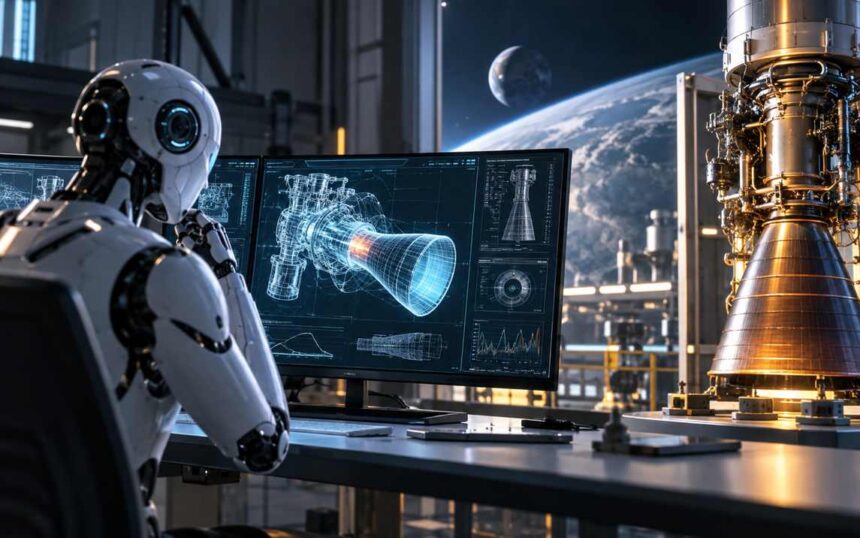
The future of space exploration directly hinges on the advancement of propulsion systems, as planned missions to the Moon, Mars, and beyond require faster and safer flights. Artificial intelligence, particularly reinforcement learning—one of its most effective branches—is already playing a decisive role in refining these technologies.
These systems learn from their own experience and numerous trials, analyzing vast amounts of data at speeds unattainable for the human brain. As a result, they help determine the most efficient trajectories for spacecraft and design complex engines that ensure optimal heat transfer to the fuel.
The role of algorithms is especially significant in the development of nuclear engines. Technologies based on nuclear fission and fusion allow for immense thrust, but optimizing the heat transfer geometry in reactors or managing plasma magnetic fields are exceptionally complex challenges.
Beyond design, artificial intelligence is also valuable for managing real-time fuel consumption during flight. This is particularly crucial for spacecraft that need to rapidly adapt their strategies and operations during a mission.

The application of artificial intelligence in space propulsion design demonstrates that the field is pushing beyond the boundaries of traditional engineering. Modeling complex physical processes, which previously required decades, is now carried out incomparably faster.
This is especially vital for nuclear technologies, where safety and efficiency standards are exceptionally high. Optimizing reactors makes it possible to reduce flight duration, which in turn diminishes radiation exposure for astronauts.



Nevertheless, the path from theoretical models to actual space trials remains long. In the next phase, the decisive factor will be how effectively these algorithms perform under real flight conditions.