



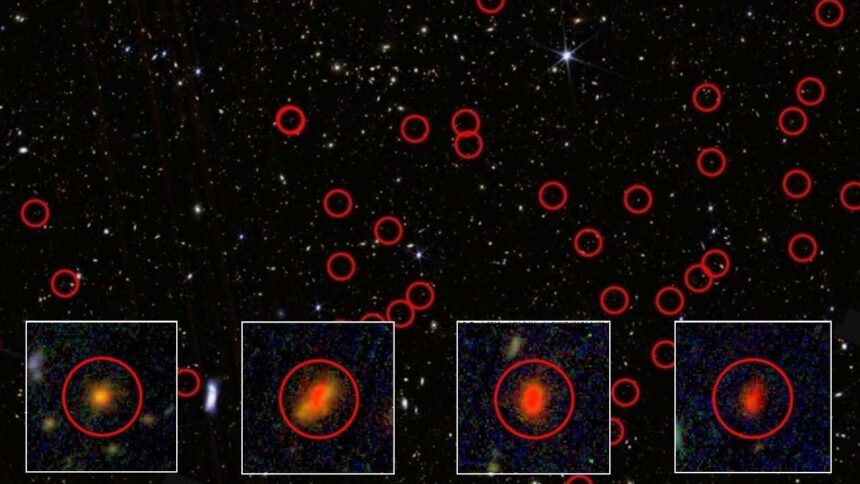
While studying deep-space images captured by NASA’s James Webb Space Telescope, researchers at the University of Missouri discovered 300 unusually bright objects in the early universe. They may be galaxies, but scientists have not yet been able to confirm their nature.
The brightness of these objects is particularly remarkable because, according to current models, galaxies forming shortly after the Big Bang should have been relatively faint, given the rate of star formation. However, the detected candidates are far brighter than those models predict.
To find the objects, the researchers used the “dropout” method, which allows scientists to identify sources visible at red wavelengths but not at shorter, bluer wavelengths. This indicates that they are extremely distant, and the light reaching us shows the universe as it existed more than 13 billion years ago.
To estimate the objects’ distances, the scientists studied their brightness at different wavelengths, determining their redshift, age and mass. Webb’s near-infrared and mid-infrared instruments are specifically designed to detect faint light coming from the distant universe.
In the next stage, the researchers plan to conduct targeted spectroscopic observations, focusing on the brightest sources. If even some of them are confirmed as early galaxies, the finding could reshape our understanding of how quickly the universe’s first structures formed. The study was published on June 27 in The Astrophysical Journal.
The main interest in this discovery is not simply the large number of objects detected. The key issue is their unusual brightness, because if they really are early galaxies, their existence must be reconciled with the models scientists use to describe the formation of the first stars and galaxies. Conclusions should still be treated cautiously, as researchers have not yet confirmed which of the 300 sources are actually galaxies.



The upcoming spectroscopic observations will therefore be crucial, as they will allow scientists to determine the nature and distance of the sources more precisely. If some of the candidates are confirmed, the study will not only add new objects to the map of the early universe but also prompt a closer reassessment of how quickly the first cosmic structures could have formed.