



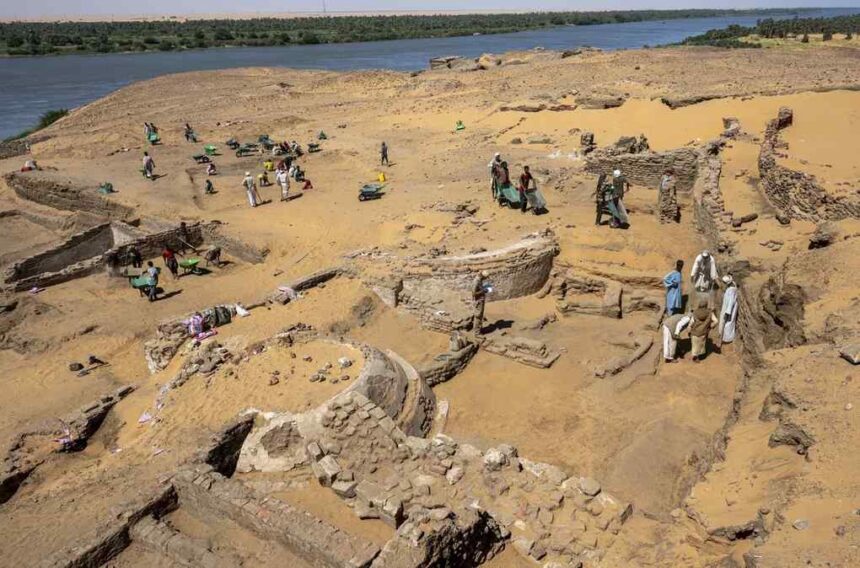
Archaeologists have uncovered architectural elements of the Great Church of Jesus, one of the largest Christian structures in medieval Nubia, in the ancient Sudanese city of Old Dongola. During the excavations, researchers reached the original floor level of the church for the first time and discovered a monumental staircase.
The excavations are being carried out by specialists from the University of Warsaw and Sudan’s National Corporation for Antiquities and Museums. Preliminary estimates suggest that the building was approximately 47 meters wide and 57 meters long, while its height may have reached 21 meters. Some walls near the staircase have survived to a height of around 11 meters.
The expedition’s leader, Professor Artur Obłuski of the University of Warsaw’s Centre of Mediterranean Archaeology, said the building was larger than the White House in Washington and that researchers intend to continue excavating it. In his view, the church may have served as an architectural model for other structures in Nubia and possibly across a wider part of Africa. He compared its historical significance to that of Hagia Sophia in present-day Istanbul.
Old Dongola stood on the eastern bank of the Nile and was the center of the Christian Kingdom of Makuria during the Middle Ages. The kingdom adopted Christianity in the sixth century, after which the city became an important religious and cultural center, with numerous churches, monasteries and large buildings. The city continued to flourish until the 14th century.

The excavations also revealed a smaller church on an upper level of the Great Church of Jesus. Although most of it has not survived, archaeologists found fragments of decorated plaster and Greek inscriptions. The surviving pieces indicate that the walls were adorned with frescoes. Six large storage racks have already been needed to accommodate the fragments.
One of the inscriptions contains an excerpt from the biblical prayer of Hannah, the mother of the prophet Samuel. It was written in Greek in neat book script, with letters approximately half a centimeter tall.


The excavations at Old Dongola show just how significant a role Christian culture may have played in Africa beyond Constantinople. The size of the Great Church of Jesus and its possible influence suggest that the Kingdom of Makuria was not merely a regional political center but also an important place in the development of architectural and religious traditions.
The significance of this discovery extends beyond the building’s sheer size. The remains of the smaller church’s frescoes and the Greek inscriptions add to a picture that cannot be reconstructed through the study of monumental structures alone. The passage of time is also a critical factor: the ongoing war in Sudan threatens the country’s cultural heritage, and every new excavation offers an opportunity to preserve parts of history that science has not yet had the chance to study. In the case of Old Dongola, continuing the research is particularly important, as the full significance of the newly discovered structure has yet to be established.