


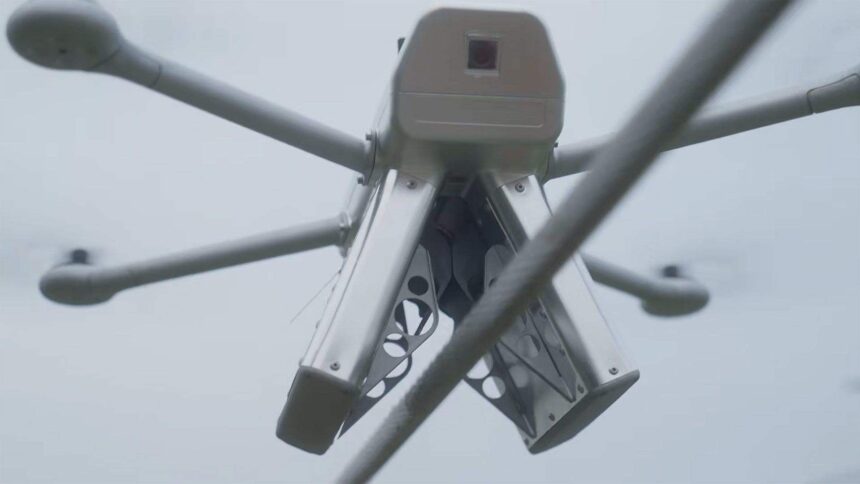
Startup Nomadic unveiled its NOMAD drones this week and announced it has raised $6 million in seed funding, allowing the quadcopters to operate nearly continuously without returning to base. The drones charge directly by perching on high-voltage power lines before moving to the next section to carry out their tasks.
No details about these devices had been published until now, though the startup says the drones have already been tested for more than 20,000 hours on lines in Germany, Norway and the United States. According to the startup, NOMADs perch on live high-voltage lines, draw power from those same lines and move along the grid to where measurements are needed.
Those measurements point to the drones' core purpose, as they monitor the very lines from which they draw energy. Power grid operators often estimate allowable capacity using weather models, whereas actual line conditions can differ significantly. According to the company, the weakest section of any line sets the limit for the entire route.
Inspecting high-voltage lines with human crews typically requires complex planning, heavy equipment and brief line outages. According to the startup, a single NOMAD drone can cover about 25 km of line, whereas fixed sensors are usually installed every 1 to 5 km.



Alongside the hardware, the startup also offers Nomadic OS software, which combines data collected by the drones with weather and grid models to give operators a real-time view. The drones have been tested in conditions down to minus 25 degrees Celsius, strong wind and voltages up to 420 kilovolts, and with the new funds the company plans to expand its fleet and primarily its engineering team in Munich.
This approach shows how mobile, self-charging systems are entering power infrastructure maintenance. Especially during winter cold snaps and strong winds, using drones could change how quickly operators spot vulnerable sections of lines.


At the same time, a question arises as to how far a single mobile device can practically replace continuous monitoring. Going forward, it will be interesting to see how fast cooperation with grid operators expands and how the Munich team develops.