




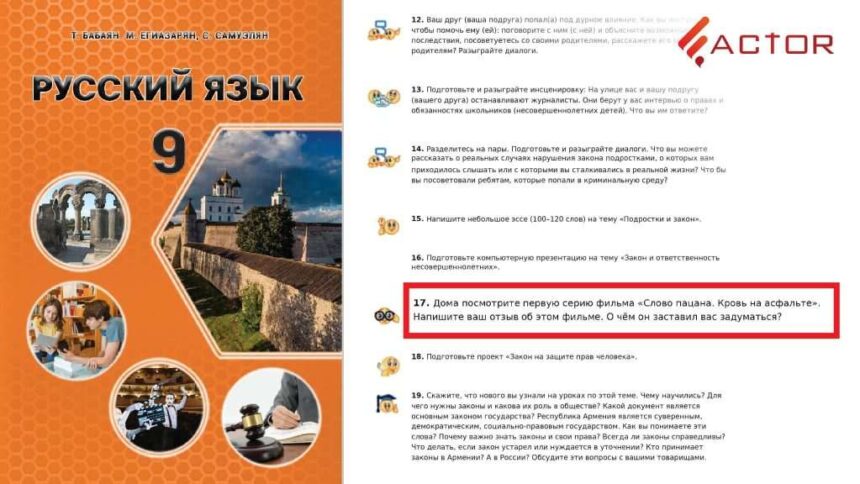
A 9th-grade Russian language textbook approved by Armenia’s Ministry of Education, Science, Culture and Sports (MESCS) instructs students to watch the first episode of the Russian series “Слово пацана. Кровь на асфальте” at home and submit a written review. The information is accurate.
The textbook, titled “Russian Language 9,” was published in 2025 by Manmar Publishing House. Its authors are T. Babayan, M. Yeghiazaryan and S. Samuelian. The electronic version is available in the Resource Repository section of the Armenian Educational Environment portal. The portal is operated by the National Center for Educational Technologies, which is subordinate to the MESCS.
Exercise 17 on page 143 asks students to watch the first episode of the series at home, write their opinion about it and explain what it made them think about. The assignment is part of a lesson titled “Laws, Rights and Responsibilities.” The textbook does not indicate that the task is optional, nor does it include any warning about age restrictions.
One of the lesson’s objectives is to familiarize students with the rights and responsibilities of minors, explain the consequences of unlawful behavior and teach them to evaluate their own actions. The same section also covers the employment rights and criminal liability of minors aged 14 and older.

“Слово пацана. Кровь на асфальте” is an eight-episode Russian crime drama released in 2023. It tells the story of street gangs and the involvement of teenagers in them in the late 1980s. The series contains scenes of fights, physical violence and violence against minors, including in the first episode assigned to students.
A statement published on Rostelecom’s official website on October 20, 2023, lists the series as suitable for viewers aged 18 and over. The same age restriction applies on Wink, one of the official platforms where the series premiered.



This case raises questions not only about the choice of this particular assignment but also about the practical effectiveness of textbook reviews. If the textbook is intended to explain the consequences of unlawful behavior to minors, the material selected for that purpose should also be appropriate for the students’ age group. Otherwise, the educational objective may take a back seat, and the assignment may be perceived simply as an instruction to watch certain content.
The fact that this is a textbook approved by the ministry is particularly significant, as the evaluation procedure explicitly requires an assessment of age-related psychology and the involvement of an educational psychologist. The issue, therefore, is not only why this particular series was chosen, but also how its suitability for 9th-grade students was assessed during the review process. A discussion by the ministry’s relevant professional departments would provide an opportunity to address these questions as well.
Clarifying the issue is especially important because the textbook is intended to remain in use until 2029. This is not a matter concerning a one-time publication, but rather the continued use of educational material. It should also be made clear whether the assignment will remain unchanged or whether the ministry plans to revise its content.