




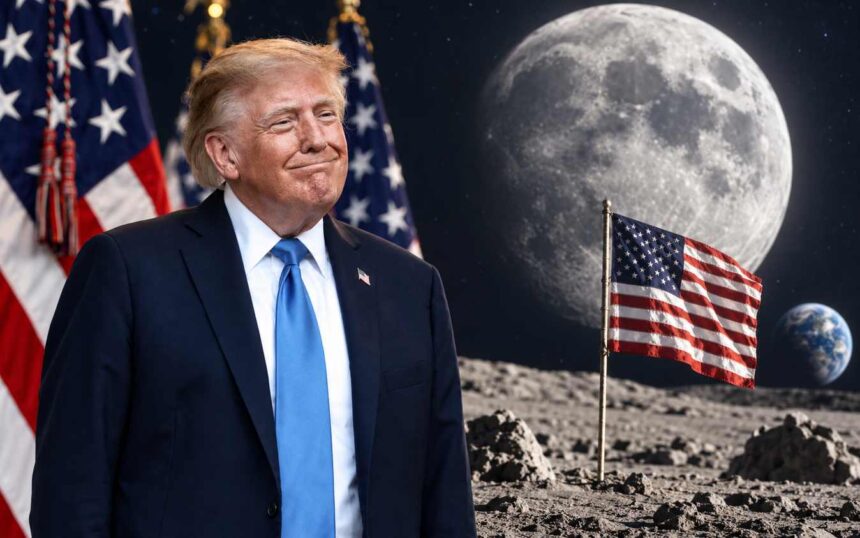
U.S. President Donald Trump has declared the Moon to be the property of the United States. He posted a photo of the Earth's satellite on the social network Truth Social, captioned "The Moon is ours" along with a U.S. flag. However, this statement directly violates the 1967 Outer Space Treaty, which was developed with the participation of Washington and signed by over 100 countries. That document explicitly prohibits the appropriation of outer space and celestial bodies through national sovereignty, use, or occupation.
Before posting about the Moon, Trump had also shared photos of new U.S. Space Force uniforms, which appeared to have been generated by artificial intelligence. He described the garments in "space gray, midnight black, silver, and satin black" tones, featuring epaulets, patches, and a belt. Internet users immediately drew parallels to the "Star Wars" films, noting their resemblance to the "Imperial Army" style.
In addition, the President had published a map of New Mexico where the word "Mexico" was crossed out in red and replaced with "America." Although such posts serve as powerful political signals, they have no legal force to change geographical names or status.
Renaming geographical objects has become a recurring theme recently. On August 27, Trump announced that amid a trade dispute with Canada, he had submitted official documents to rename Lake Ontario to "Lake America." The lake's name has a 400-year history and originates from the indigenous Wyandot language, where it means "beautiful lake." The Grand Chief of the Wyandot nation, Pierre Picard, strongly criticized this decision, noting that Trump is attempting to erase their history for political branding.
Donald Trump's statements regarding the Moon, New Mexico, or the renaming of Lake Ontario might seem at first glance like ordinary sensationalist social media posts. However, they reflect the general logic of the administration's political rhetoric, where national symbols and territorial ambitions are used to send signals to a domestic audience.
From a legal standpoint, these steps have no consequences, as international treaties and official procedures require entirely different mechanisms. The 1967 Outer Space Treaty clearly limits any state's sovereignty over celestial bodies, and changing geographical names requires international and bilateral agreements.

Therefore, such statements should be viewed not as legal facts, but as tools for political propaganda and shaping the information agenda.