



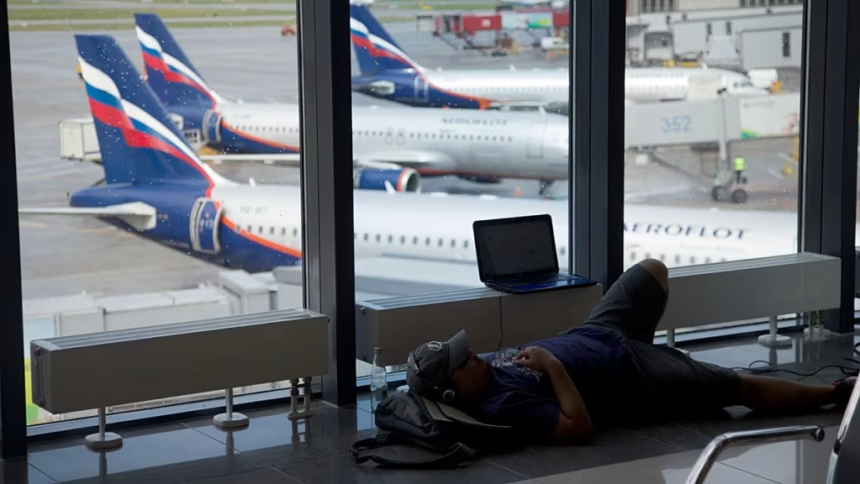
Moscow and St. Petersburg airports suspended operations overnight due to drone activity. Restrictions in Moscow were lifted only in the early hours of October 16, while St. Petersburg’s Pulkovo Airport resumed operations at 9 a.m.
Nearly 160 flights were delayed or canceled at Moscow airports, including 66 at Vnukovo and 79 at Sheremetyevo. At Pulkovo, 37 departures were delayed, while the arrival of another nine flights was also delayed.
Moscow Mayor Sergei Sobyanin said air defense forces had intercepted 94 Ukrainian drones heading toward the Russian capital since the evening. According to Leningrad Region Governor Alexander Drozdenko, another four drones were shot down in the region’s skies.
The Atlantic journalist Simon Shuster, citing his sources, wrote that Ukraine’s campaign to disrupt operations at Russian airports was only just beginning. On September 1, Ukrainian President Volodymyr Zelenskyy said Russian airspace was becoming unsafe and that the country would have to contend with drones appearing in its skies more frequently.


According to Shuster, in recent weeks Ukraine has been using long-range drones in an effort to make airspace around Russian airports more difficult to use. However, Zelenskyy has not yet approved an initial plan that called for a significantly more aggressive approach.
Disruptions at Moscow airports have become more frequent in October. During the first 14 days of the month, Moscow’s four airports were closed for a combined total of 101 hours, compared with just 46 hours throughout September.



The recurring suspension of airport operations is no longer simply a matter of individual flight delays. Data from the first two weeks of October show that restrictions in Moscow have been imposed significantly more frequently than in September. For passengers, this means greater uncertainty, as flight schedules can change even when restrictions are lifted just a few hours later.
Discussions surrounding Ukraine’s use of long-range drones still reveal a significant gap between its stated objectives and the actions being considered. According to the information presented by Shuster, the preliminary plan for a more aggressive approach has not yet been approved. The growing frequency of airport disruptions therefore illustrates the scale of the existing problem, but does not in itself establish how future operations will develop.