

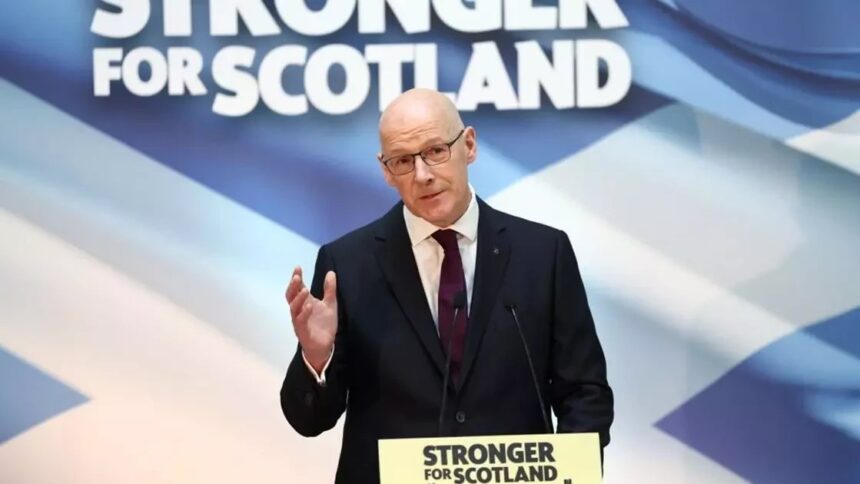
Scotland's government leader John Swinney has announced that the campaign to hold a second referendum on independence has already begun. He said this in a speech at the Scottish National Party (SNP) conference in Aberdeen, announcing the launch of the nationwide Choose Scotland initiative, which is intended to convince voters of the benefits of leaving the United Kingdom.
Swinney noted that the party intends to conduct "the most carefully considered campaign in its history," allocating a six-figure sum in British pounds for it. The goal of the initiative is to secure broad public support for independence. "Independence is very close," he declared, adding that supporters of independence for Scotland, Wales, and Ireland are beginning to cooperate more closely, which he considers a sign of favorable changes for the national movement.
The SNP leadership hopes that in the next UK parliamentary election the party will be able to significantly increase its number of mandates in the House of Commons and gain the opportunity to influence the formation of a government. If no political force receives a majority, the Scottish nationalists could find themselves in a position that would allow them to achieve negotiations on a new referendum.
Scotland's Deputy First Minister Jenny Gilruth has stated that the party would welcome snap elections, which could give new momentum to the independence campaign. MP Lara Bird also called for using the possible balance of power in parliament to demand that a future UK government agree to a plan for holding the vote.
At the same time, forecasts regarding the SNP's results differ. According to an Electoral Calculus projection published this week, the party could receive 28 seats in parliament, while other polls allow for a more significant increase in its representation.
The launch of the campaign itself does not yet mean a referendum. The Scottish government cannot independently schedule a vote; this requires London's consent, and this is precisely where Swinney's calculation becomes most vulnerable. He is betting not on today's public mood but on the outcome of the next parliamentary election, hoping that in a hung parliament the SNP's votes will become a necessary lever.


But it is precisely that calculation that is the most unstable. The Electoral Calculus projection — 28 seats — is a serious signal: if that figure approaches reality, then the "opportunity to influence" that the party speaks of may remain only theoretical. The better picture from other polls still does not guarantee that the voter is ready to vote on the independence agenda rather than on everyday problems.
Burnham's call to move away from the constitutional question and deal with the cost of living essentially hints at where the reader's real attention lies. If economic pressure does not ease, the strongest argument of the independence campaign may become not sovereignty but discontent. In that case, the question will be not "can Scotland become independent" but "does the voter consider that a priority."