




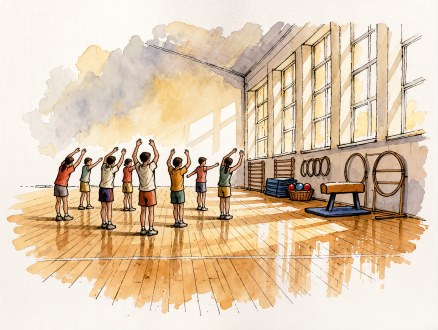
The amendments to the State Curriculum for General Education have completely abolished numerical grading for physical education. This change applies to all students, from primary school up to the 12th grade. The regulation is defined by a government-approved curriculum, with the new edition in effect since May 2026, though many parents remain unaware of the update.
Under the new rules, numerical grading has been eliminated for all subjects in grades 1-4 and for the first semester of grade 5. Furthermore, no grades will be assigned in grades 5-12 for subjects within the fields of "Physical Education and Healthy, Safe Lifestyle" and "Arts and Crafts." This means that physical education, initial military training, music, fine arts, technology, and safety-related courses are now exempt from traditional numerical scores.
Instead of conventional grades, diagnostic assessments will be used at the beginning of the academic stage, followed by formative assessments throughout the process. At the end of each semester, a progress report for each student will be compiled for every subject, replacing the final numerical score. The specific forms and methods of formative assessment are chosen by the schools themselves, which may lead to varying approaches across different educational institutions.
In the 10-point grading scale used for other subjects, there are no longer "failing" grades, as every mark represents a certain level of achievement. The absence of a grade does not mean the subject is optional, and the progress report serves as a full-fledged component of the graduation documentation. Additionally, new ranges for weekly workloads have been established, and the total duration of breaks throughout the day must be between 45 and 90 minutes.


This change fundamentally alters the school environment's approach to non-academic subjects. For many years, grades in physical education or art often created additional pressure for students who lacked specific physical abilities or artistic talent.
It is noteworthy that the transition to a descriptive assessment system grants schools greater freedom while simultaneously presenting new challenges. Since individual educational institutions determine their own formative assessment methods, the quality of education and approaches may vary significantly between neighboring schools.



In the coming months, it will become clear how prepared teachers and parents are for this new format. The main question remains whether the descriptive system will devolve into mere formal paperwork, potentially stripping the reform of its primary purpose.