



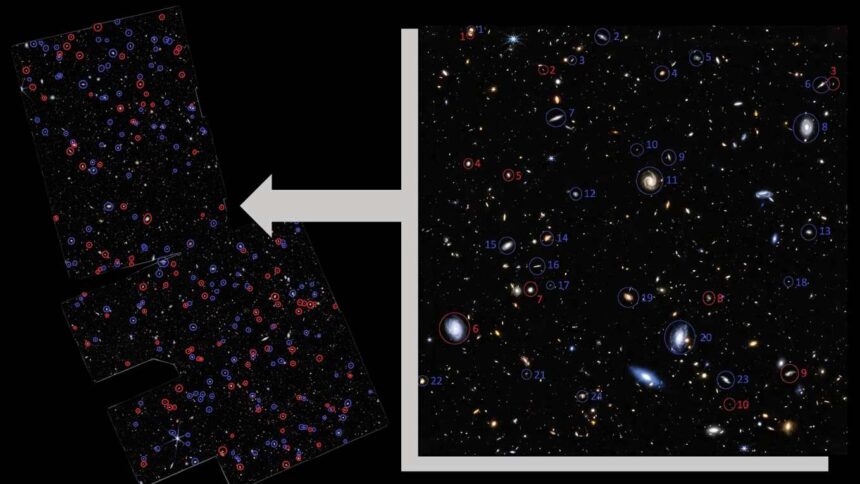
New observations by the James Webb Space Telescope could raise new questions about the origins of the Universe. The telescope has detected a preference for the same direction of rotation in most galaxies observed deep in the early Universe, which does not match the expectation of a random distribution.
The JADES study examined 263 galaxies, about two-thirds of which rotate clockwise, while the remaining third rotate counterclockwise. If direction in the Universe were random, scientists would expect an approximately 50/50 ratio.
The study’s lead researcher, Lior Shamir, said there are two main possible explanations for the phenomenon. One suggests that the Universe may have been born in a rotating state, which is consistent with some ideas in black hole cosmology. According to that theory, our observable Universe could be located inside a black hole in a larger “parent” Universe.
This approach also suggests that every black hole in the Universe could be linked to the emergence of a new “baby” Universe. According to Nikodem Popławski’s theory, matter inside a black hole may not be compressed into a singularity but instead reach an extremely high yet finite density and then begin expanding, which could theoretically be connected to the Big Bang.
At the same time, there is another possible explanation: the apparent asymmetry in the rotation of galaxies could be related to the influence of the Milky Way’s own rotation. If this is confirmed, it would be necessary to recalibrate measurements of distances in the distant Universe, which could also relate to some unresolved questions about the rates of cosmic expansion and the ages of galaxies. The study was published in the Monthly Notices of the Royal Astronomical Society.
The most interesting aspect of this observation is that it is not simply a statistical difference in the rotation of galaxies: if the asymmetry is confirmed and cannot be explained by observational conditions, the issue would become part of a broader discussion about the structure of the Universe. In that case, it would be necessary to determine whether we are seeing some preferred direction preserved from the time of the Universe’s birth, or whether the rotation of our own galaxy is affecting the measurements.



The key uncertainty here is still the question of the cause. The same data could provide a basis for different theoretical interpretations, and confirming any of them requires determining whether the observed asymmetry is a real cosmic phenomenon or a factor affecting the measurements. That distinction is significant because the first possibility would require revisiting some current ideas about the Universe, while the second would call for changes to approaches used to measure distances.