



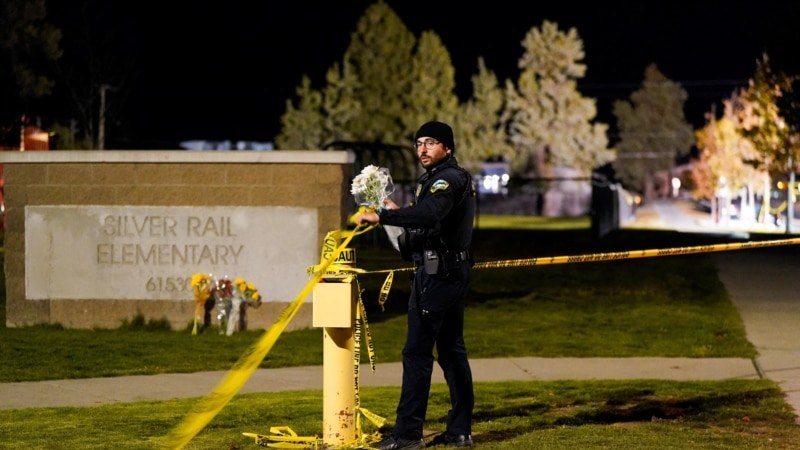
A 16-year-old teenager opened fire at an elementary school in Bend, Oregon, killing three children and a teacher. The shooter was then killed by a witness, local police reported.
The suspect, whose name has not been released, entered Silver Rail Elementary School in Bend at midday, shooting at locked doors to force his way in, said city police Chief Mike Krantz. The three children killed were five, eight and 11 years old. A seven-year-old child and a 54-year-old teacher were taken to hospital in serious condition, Krantz said. It is unclear whether the attacker had any connection to the school. Police have not disclosed further details about the identity of the shooter or the victims.
Local media note that the school received new classroom doors in 2022 that can be locked with a single touch.
According to police, a member of the community saw the shooting begin, chased the shooter and entered the school, where he shot and killed him. Police arrived at the scene three minutes after receiving the alert. Officers confirmed the attacker had been killed and then searched the school.


Oregon Governor Tina Kotek praised the civilian who killed the shooter, saying he "heroically intervened" to prevent further loss of life. "Your actions carry a heavy emotional burden, and I simply want you to know that my thoughts are with you as well," she said at a press conference she convened.
Such incidents are frequent in American schools. On August 27, 2025, a similar attack at a Catholic school in Minneapolis, Minnesota, killed two children and wounded 17. In September 2024, four people were killed and nine wounded at a school in Winder, Georgia. However, the deadliest attack occurred at Sandy Hook Elementary School in Newtown, Connecticut, on December 14, 2012. That attack killed 27 people (20 of them first-graders) as well as six school staff members.



The series of such attacks on schools has long ceased to be a collection of random incidents; it has become a recurring pattern to which the United States still has no unified, lasting solution. The Bend case once again showed that the first responder is often not the state system but an ordinary citizen who decides to act within seconds. That is both comforting and troubling: comforting because there are people willing to risk their lives, troubling because in such cases the death toll depends not on response time but on the degree of chance.
Particularly noteworthy are the details of the school's security measures, mentioned as a reform carried out in 2022. They did not prevent entry, which raises the question of how much such investments function as real protection rather than merely an illusion of confidence.
In the coming days, two questions are most likely to be in the spotlight: whether the shooter's motives will be made public, and whether school safety standards will be reviewed at the state level. For small communities like Bend, this is not only a painful loss but also an urgent question about how prepared they are for the next such case.