

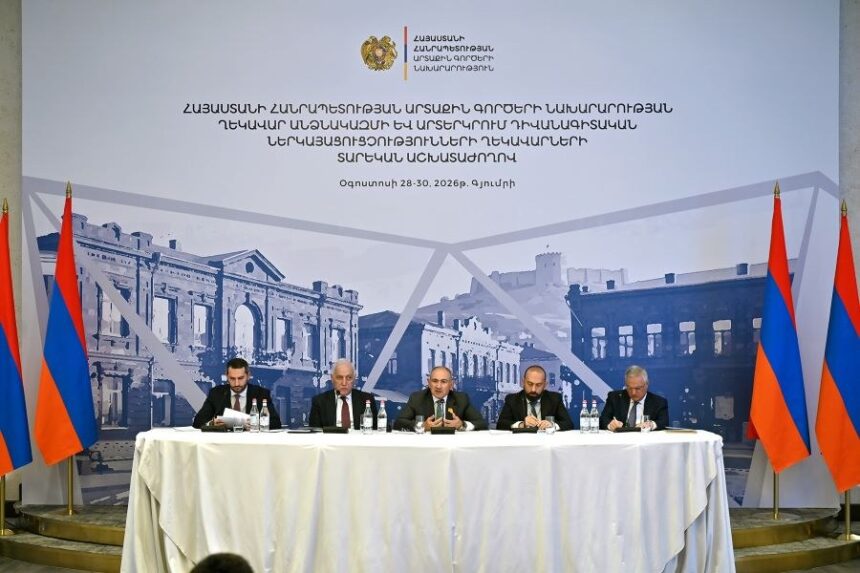
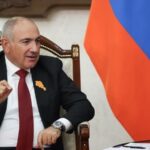
Armenian President Vahagn Khachaturyan delivered a speech at the annual conference of heads of Armenia's diplomatic missions. He emphasized that in a rapidly changing world, the logic of international relations and the toolkit of diplomacy are evolving. According to him, Armenia as a sovereign state is also changing, as evidenced by the incredible transformations that have taken place in the country over the past year.
Khachaturyan noted that diplomacy is not limited to political relations alone, as they are closely tied to the economic factor. For that reason, the Government decided to expand the functions of the Ministry of Foreign Affairs to include international trade. In 1990–1991, this function was carried out by the Ministry of Foreign Economic Relations of Armenia, after which it was transferred to the government. The President fully agrees with the Prime Minister's view that the work of ambassadors should also be evaluated by the volume and growth of trade and economic relations.
Touching upon the internal situation, Khachaturyan quoted economist Daron Acemoglu, who back in 2013 noted that Armenia's problem was political, rather than geographical or cultural. In the President's assessment, after the 1991 independence referendum, the country transformed into a clannish and corrupt system whose existence was conditioned solely by a "third power." The situation changed after the 2018 Velvet Revolution, when the government began a consistent fight against corruption and patronage.
According to Khachaturyan, from 1994 to 2022 Armenia suffered from a "duality complex," as it maintained a demanding stance internally while acting as a subject of international law externally. The 2022 Prague Summit became the starting point that enabled the country to act as a sovereign and predictable state, ready to face reality and make pragmatic decisions.
Setting a clear requirement for the diplomatic service to evaluate performance based on economic indicators shows that foreign policy priorities are being reformulated. The shift from political rhetoric to demanding concrete growth in trade volume will require serious changes in the operating format of embassies.
At the same time, the reference to the 2022 Prague Summit and the discourse on the "duality complex" highlight a trend toward the ultimate pragmatization of foreign policy. In the coming period, it will become clear to what extent the new toolkit of economic diplomacy will succeed in securing the declared sovereignty and stability.