




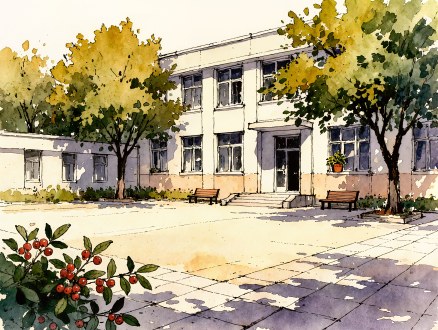
Trees in schoolyards and potted plants in classrooms are usually viewed purely as a matter of aesthetics, but in reality, they are subject to a direct sanitary prohibition. The requirement is established under the sanitary rules and standards approved by Order No. 12-N of the Minister of Health of the Republic of Armenia, dated March 28, 2017.
Clause 33 of the rules establishes two separate prohibitions for outdoor and indoor areas. When landscaping a school's land plot, the presence of trees and shrubs with poisonous fruits must be excluded. Meanwhile, inside the building—in classrooms, corridors, and halls—placing decorative plants with toxic properties or poisonous fruits is prohibited.
The two prohibitions are not identical. The restriction for the outdoor yard applies only to fruits, whereas indoors, it is sufficient for the plant to possess toxic properties, even if it bears no fruit.
The key problem is that the sanitary standards do not contain an exhaustive list of poisonous plants or trees. The rules define only the criteria, leaving the specific list of species open. This means that when selecting plants, the educational institution itself must conduct the evaluation based on professional data.
These requirements apply to all educational institutions implementing general education programs, regardless of their form of ownership or departmental affiliation. If parents notice plants that appear toxic, they can raise the issue with the school administration or the parents' council, while oversight is carried out by the authorized body.
This situation illustrates how a legal norm enacted with good intentions can create uncertainty in practice. The legislator set a clear requirement—to ensure children's safety—but failed to provide the practical toolkit for its implementation.



In the absence of an official list of toxic plants, the entire burden of responsibility falls on school administrations. Lacking professional botanical education, school staff are forced to determine independently which plants are dangerous and which are not. This can lead to completely different standards being applied across different schools.
The only logical solution to the issue would be for the Ministry of Health to approve an appropriate guideline or an explicit list of prohibited species. Until then, to minimize risks, schools are forced to consult with specialists or simply forgo any suspicious plants altogether.