




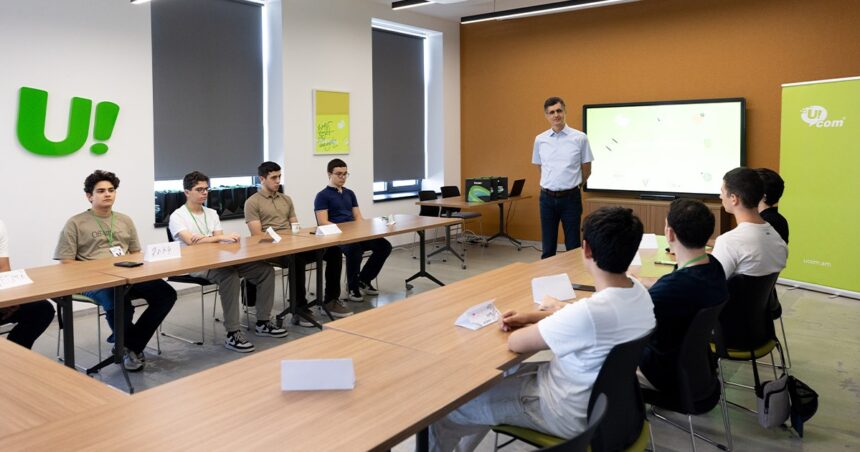
Graduates of the 'Cybersecurity Educational Program for Schoolchildren' course, implemented by the Microsoft Innovation Center with the support of Ucom, participated in Ucom's two-week 'Junior Academy' program, where they had the opportunity to deepen their knowledge of cybersecurity and the application of modern technologies in the telecommunications sector.
Ucom's experienced specialists held a series of theoretical and practical meetings for the teenagers, presenting the intricacies of teamwork and crisis management, principles of effective communication, as well as the critical role of cybersecurity in telecommunications and the professional and career opportunities available in this field. Participants not only attended lectures but also interacted directly with specialists from various areas, learned about their daily work, and clarified all their questions during open discussions.
The 'Junior Academy' program was effectively shaped as a logical continuation of the 'Cybersecurity Educational Program for Schoolchildren' initiative: upon completion of the course, participants independently expressed a desire to get a closer look at Ucom's working environment and understand how the theoretical knowledge they gained is applied in a real company. This two-week intensive program was organized on the initiative of Ucom CEO Ralph Yirikian, responding appropriately to the teenagers' interest.
'For Ucom, contributing to the professional orientation of young people is not just an educational initiative, but a real investment in the development of Armenia's future technological potential, because progress in the field depends not only on innovative solutions, but also on the people who will create and develop them,' emphasized Ralph Yirikian, adding that Ucom is always ready to make its experience, knowledge and professional environment accessible to young people, helping them to more confidently envision their opportunities and future professional paths.



This initiative is notable in that the company does not merely provide a grant or a one-off course, but opens its doors and demonstrates in a real working environment how 'living' technologies operate. This is the format that schoolchildren need most – not abstract theory, but an opportunity to see, touch and understand what real industry experts do.
Equally interesting is the children's proactiveness; they were not passive participants, but initiated this program themselves, expressing a desire after the course to delve deeper into the company's operations. Perhaps this is the true key to education – when learning continues from the point where the textbook ends, and direct interaction with professionals begins.



In the near future, it will be worth tracking how many of today's students will end up on the teams of Ucom or similar technology companies in a few years, because such programs often determine young people's future choices far more powerfully than any career guide.