




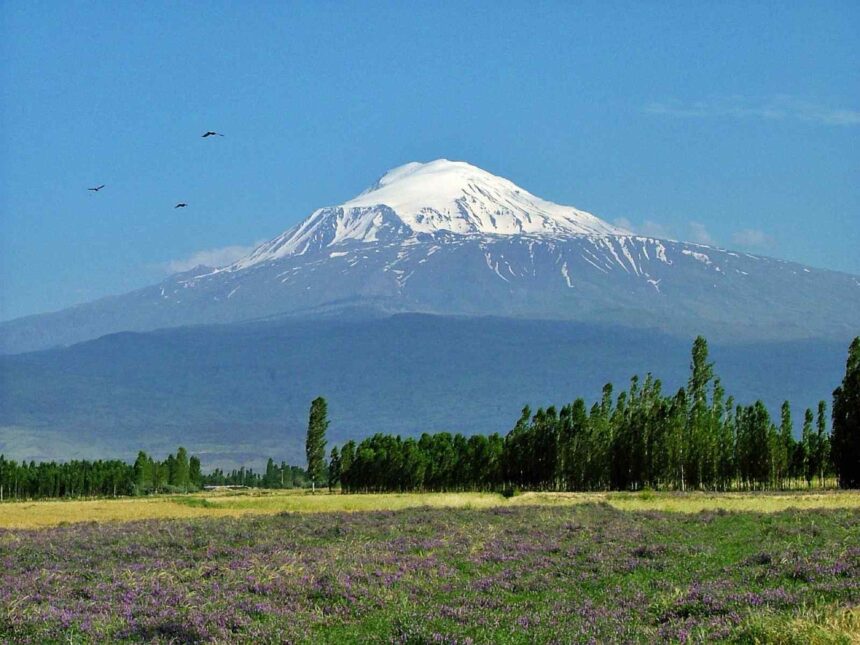
A German-Turkish scientific team is studying the glaciers of Mount Ararat to uncover the region's climatic and environmental history spanning millennia, and the work is already yielding its first results.
In July 2026, researchers took ice samples from the summit area of Mount Ararat, at an altitude of over 5,000 meters, using specialized ground-penetrating radar and seismic measurements that allow them to determine the thickness and structure of the ice sheets.
The ice on Ararat serves as a unique natural archive for scientists, as air bubbles preserved within the ice sheets can provide information about past atmospheric composition, volcanic eruptions, dust dispersion, and climatic changes.
The researchers are particularly interested in periods for which data on the Middle East and the Caucasus are very limited. For instance, the Ararat glaciers could offer entirely new insights into the Roman Climatic Optimum and the climatic cold period of the 6th and 7th centuries.
Due to climate change, Ararat's ice cover is rapidly diminishing, and scientists are concerned that the valuable information preserved in the ice could be irreversibly lost if not collected in time.
During the next expedition, the team plans to obtain, for the first time on Ararat, a long, ancient, and continuous ice core, as well as to search the ice for indirect traces of early human activity, including particles related to metalworking or early agriculture.



Despite Ararat's legendary connection to the story of Noah, the researchers emphasize that they are not searching for Noah's Ark; their goal is to study the ice and the rocks beneath it, which may tell much older and more genuine stories.
This research is significant not only scientifically but also in a regional context, as data from the Ararat glaciers could fill many gaps in the climatic history of the Middle East and the Caucasus.
Particularly intriguing is the fact that the scientists are looking for traces of early human activity, meaning this expedition could yield not only natural but also cultural and historical discoveries. At the same time, the rapid melting of ice due to climate change has turned this work into a race against time, and perhaps now is the last chance to extract maximum information from this natural archive.